Showing posts with label Shared Post. Show all posts

Wednesday, 30 March 2016

Evaluation- Technology we Learned to Used

Technology Used


Pre-production:

The only piece of outstanding technology we used during pre-production was celtx which is a free online screenwriting software which we used to format our script. Sam had used this product before so was familiar with it, and it proved very useful in the process of writing and planning our film. We could have written the film in Microsoft Word, or even by hand, but using celtx made it much quicker and easier to format our idea into a screenplay style.


Production:

Instead of using the school's camcorders for our film, we decided to use Sam's Canon 600D DSLR camera. DSLRs (Digital Single Lens Reflex) generally have a more cinematic quality to them than camcorders because of their larger sensors (APSC in the case of the Canon 600D), plus they have the ability to use interchangeable lenses. Because we knew the film would be set at night and would therefore be very dark, we chose to use lenses which opened up to f/1.4 and f/1.7 to let in as much light as possible. However this also meant that the depth of field was very shallow meaning that focus was an issue. Fortunately Sam had some experience in focussing manually while shooting wide open, so it was less of an issue than it could have been.


We used two lenses in our film, the Sigma 30mm f/1.4 and the Yashica 50mm f/1.7. They are both quite sharp and opened up very wide to let lots of light in. However, neither of the lenses has IS (Image Stabilisation) and so we had to use a camera rig to stabilise the footage.
The one major drawback of using DSLRs for filming is the poor quality of the on-camera microphone. If we had dialogue in the film, we would have had to use a boom pole with an additional audio recorder, which we did not have enough crew members to use. However, as we didn't need dialogue, we attached a Rode Videomic to the top of the camera to pick up ambient noises, and decided to record most of the sounds through foley and add them in post.


To light the film, we used one 800W tungsten redhead with some CTO (colour temperature orange) to act as a key when the spy sits down at the table. We also used a small table lamp to illuminate the hallway. By pointing it to the floor, and bouncing it off some CTB (colour temperature blue) it gave the light a very diffused quality which contrasted well with the key light at the table. We also turned on a bathroom light in the corridor to stop it from being too dark (as can be seen on our behind the scenes video).


Post-production:
We edited the film on Final Cut Pro X on an iMac. Before this film, none of us in the group were experienced in using macs, but we very quickly became used to the operating system. Nonetheless it was quite easy to learn and the computer was very quick which meant that render times were low so we could experiment with various edits easily. We exported the film in ProRes which was a high quality option so we could preserve image quality.


Sound:

We had to record foley for most of the film, and so we used the Zoom H1 because it is a very compact and easy to use audio recorder with a built in microphone. It was easy to bring to school when necessary and can record very high quality audio.

Overall:
Throughout the making of this film, we learnt a lot about how to make technology work for us, and not the other way around. We learnt how to confidently edit on Final Cut Pro X, how to use macs, and how to use blogger.

Tuesday, 29 March 2016

Evaluation- Representation of Social Groups

Representation


As there are only two characters in this piece, very few social groups have been represented. Our opening involves a young adult Caucasian female and a Caucasian male in his mid-twenties. In terms of gender this is fairly representative of the general population, although it does not represent people who do not fit into the gender binary. In terms of race and age this is not very representative of the whole population as it pretty much only represents Caucasians in their early/mid-twenties.

The spy:

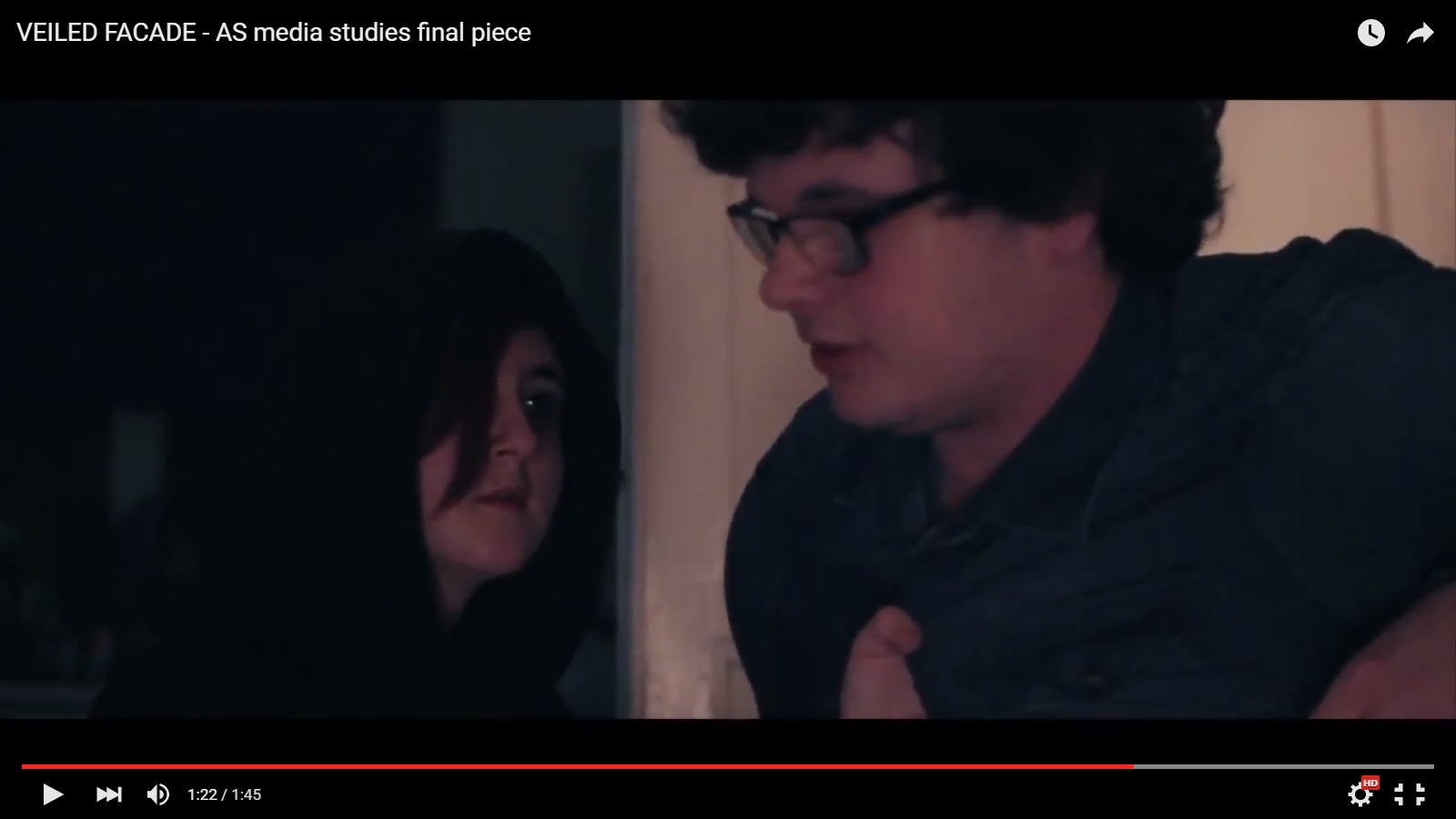
When deciding the character of the spy, we wanted to stick to genre conventions which generally involve a 30-something year old Caucasian man. This character is used because it represents the sort of person the film is targeted towards, as action/thrillers are generally targeted towards young men. This can be seen in a multitude of spy films, including very famous ones such as James Bond films, Mission: Impossible, and the Bourne series. We tried to make our character as close to this as we could, although we had a fairly limited selection of people to choose from. As a result we cast Oliver as a spy, even though he was slightly younger than the 'typical' spy.


The assassin:

I was the role of the assassin. Our main debate about the assassin was about gender, as the gender of assassins in movies is quite varied. In the past, killers have almost always been male - however, in recent times there has been a huge influx in the number of female assassins, although there is still variation in gender. In films like the Bourne series, for example, assassins are male, whilst in others, such as Kill Bill, assassins are female. In the end we decided to go with female. I was chosen as the assassin partly due to the fact I was available and willing to act. Female assassins often seem to be more mysterious and dangerous compared to male ones (this is evident in films such as Kill Bill where the women come across as more aggressive, this is probably played by the stereotype "men are the stronger sex, women are nurturing") thus making it seem more exciting and fit into slightly more modern action-thrillers. 


Age and ethnicity:

In terms of age and ethnicity, our film is not very representative. Both of the actors are young adults, and both are Caucasian. However, there are reasons for these choices. As for age, we decided that using fairly young actors made sense, for both spies and assassins the jobs are quite active and dangerous, therefore requiring younger people. The level of risk means that older people are less likely to survive and their experience would make them more likely to have jobs in organisation or leadership. Therefore don't fit the convention in using young adults exactly.


However, for ethnicity we decided to stick to genre conventions in our choices. The genre conventions of action/thrillers is to have Caucasian actors as the main parts. Some examples of this would be James Bond and Jason Bourne in terms of spies and Mad Max, Die Hard and Taken in terms of action/thrillers generally. In all of these, the main protagonist(s) are white. As well as this, in the context of the film it makes sense to have Caucasian actors considering it's set in England where the vast majority of the population are white. It therefore makes sense to use Caucasian actors in our opening.

Evaluation- Target Audience: who and how

Audience Approach 


ln order to assess our potential audience, we decided to research what sort of people would be interested in action/thriller films. Generally speaking, action/thriller films are targeted at young men aged about 12 - 30. Since our film is a 12, it is less likely that people younger than that age will watch our film. However, we decided to do our own research to see how true this would be. Below are our findings from the surveys.


These findings confirm the belief that males prefer action/thrillers more than females do, which is shown by the fact that 9 males listed action or thriller as their favourite genre compared to 5 females. However, the result for age was different compared to expected, as the age for both genders is very spread out. One interesting feature is that thrillers are enjoyed much more than action, which suggests that the combination of the two genres is likely to attract a larger and more varied audience of all ages.

Audience Attraction:

We decided to create our poster in order to attract an audience to our film. We ensured it would match the genre by both looking at genre conventions and asking people what our poster sketches suggested about our film. This was, in fact, how we decided to scrap our original plan - when asking around, people thought the idea sounded more like the poster for a horror movie, which is not what our film is. We therefore came up with another sketch, and showed it to the people who took our survey. We recorded the responses, and found that the majority of people recognised it as being an action/thriller, although a few still thought it might be a horror. We then asked if they would want to see this movie, and those who enjoyed action/thrillers said that they would. This shows that it would be a good way to attract an audience.

Another way in which we could have attracted an audience would have been by producing a trailer showing some of the good (but obviously not best) moments of our film. We would need to intrigue them in a way that would make them want to come to our film and without giving the whole plot away as some trailers do. This would be a good way to captivate an audience and draw them to our film.

Wednesday, 13 January 2016

Set Design

Set Design

When it finally got to the stage of filming we had to get ourselves prepared for it all. Of course we all had a rough idea as to what we were doing but setting it all up physically is another thing. Thankfully our group get on incredibly well with each other and it really brought a benefit to us.

Prop use in set-up:
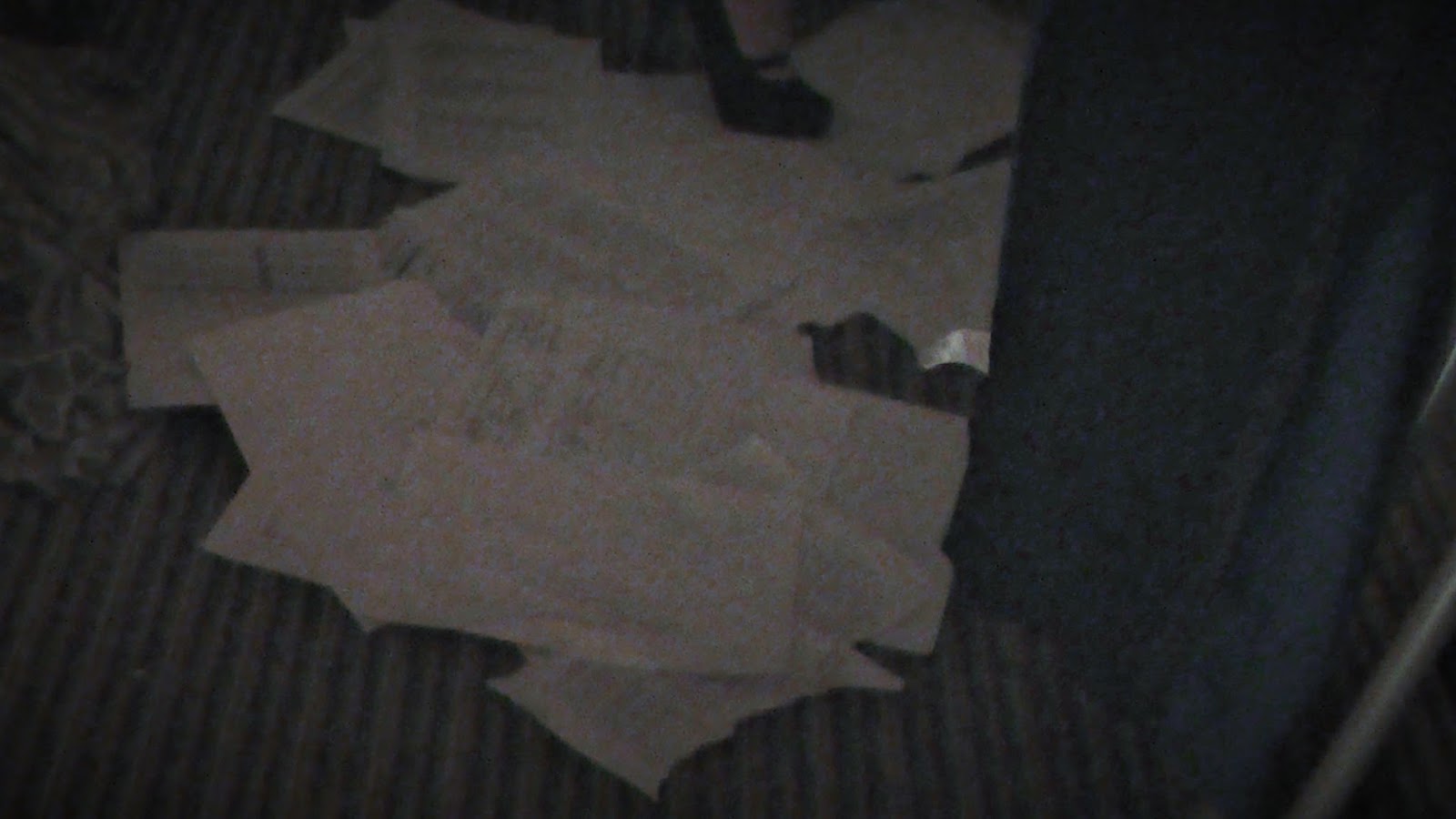
Setting up was great fun due to a great deal of it being just mess making. Some props we used were great at creating an atmosphere. Paperwork was used to encourage the viewer into believing it has some significance in the householder's (the spy's) life. The reason for the paperwork being a mess is to show some disturbance.

Surroundings:
It also came in very handy to use objects that were already in the home. As you can see above we used a table but below you can see a coffee table and unit was used that weren't even seen in the opening sequence much at all... This was done because we felt like it made it look more realistic instead of staged.


Lighting:
Lighting brings an incredible contribution to atmosphere in films and so, we used it for our opening sequence set. Thank goodness Samuel (a member of our group) has a professional lighting set which we used to our benefit. Different coloured lighting gels were used to change what colour of light was used. Toward the main door we had a tint of blue (CTB- Colour Temperature Blue) because it was a very calm colour and reflected the wallpaper. The main room was an orange sheet (CTO- Colour Temperature Orange) so it was more neutral, without the sheet it would have been over powering and less effective for the genre we are using (action-thriller).

Thursday, 10 December 2015

Symbol Investigation

Symbols for our opening sequence

Research and planning
As a group we decided to have a symbol to represent an organization within the film. We didn't really want to use something that is already out there so we decided to create an original.
We used research to find some symbols and to look at different meanings behind them. The decision came about to combine several symbols together with specific meanings that would work well for our 'organisation'.
Here are some possible ideas:


Here is our final idea:

This symbol (which we created) is called Arc Diath and has the following meaning: Ambition, determination, potential, beginning, strength, tension and uncontrolled energy.

Wednesday, 2 December 2015

Audience

Target Audience Research

We believe that the target audience for our film would be young adults of any gender. We think this because action/thrillers are generally fast-paced films that are more suiting to a younger audience. Generally, action films are more suited towards younger people, especially teenagers, as they prefer excitement and fast-paced action. However, thriller films are more targeted towards older people as they require more thought and often intellectually challenge the audience, therefore drawing a more mature strand of people. By having a film that is a combination of these two genres we believe that our audience will be quite diverse - it will attract the thrill-seeking younger people whilst having enough intelligence to attract older people, without having too much of either side so as to put anyone off.

An example of this would be Skyfall, a James Bond spy movie with similar themes to how ours will be. A report from Box Office Mojo stated that on the opening night 'the audience was 60 percent male and 75 percent were 25 years of age or older'. This shows that males are slightly more likely to watch this film than females, as expected. The action/thriller film attracted mostly over 25s, suggesting that the audience is more likely to be adults; however, younger people still made up 1/4 of the audience, showing that it is still enjoyed by the younger generation. Similar to this is the data for Mission: Impossible - Ghost Protocol. Another report states that 'the audience was 61 percent male and 65 percent over the age of 25', which is similar to the Skyfall data and so further backs up our claims.


Although these films suggest that most of our audience would be 25 and over, as our rating is a 12 we can expect our audience to be a mix of people over 12. Most action/thriller films are rated either PG (Mission: Impossible, Bourne Identity) or 12 (Skyfall, Batman Begins). This shows that the minimum age for action/thriller films is quite low, suggesting that our film would be suitable for a pretty large range of people.

Sunday, 29 November 2015

Ratings

Analysis of BBFC Ratings
The BBFC stands for the British Board of Film Classification. They are an organisation that gives films age ratings to allow people to know whether a film is suitable or not. There are several age ratings, and the content of the movie determines its rating. However, the guidelines are not especially strict, and are generally only enforced in cinema viewings and DVD sales. The movies someone watches is entirely up to them or their parents/guardians. Here are the guidelines for age rating movies:


     U

U stands for Universal, and can be watched by all. Most films with a 'U' rating are made for young children, generally under 4 years old. It may include:

  • VERY mild language (such as damn)
  • VERY mild sexual behaviour (such as kissing or hugging)
  • VERY mild violence and threats, and a good outcome is always assured
  • No dangerous or anti-social behaviour that a child might copy
  • Rarely any reference to drugs


     PG

PG stands for Parental Guidance. This means that most people should be able to watch it, but some scenes my be unsuitable for young children. It suggests that parents should review the content of the film before showing younger children. Although the films are generally suitable for children, they may not have been expressly made for children. A PG film may include:
  • Mild language, although generally infrequently, and with little or no aggression - it depends on context
  • Mild sexual reference/behaviour, if any at all - again, it depends on context
  • Mild violence or threat
  • Some dangerous or anti-social behaviour may be shown (for example bullying) providing it is portrayed as wrong or unpleasant, and not glamorized
  • There may be references to drugs, although these are not focused on, and are portrayed as negative


     12 and 12A

12 and 12A are very similar, but are used for different reasons. Both mean that the content should be suitable for people aged 12 and over. 12's are used for DVD ratings, and only people over 12 can buy them. 12A is used for cinema releases, and means that under 12s can enter if accompanied by an adult. A 12/12A film may include:
  • A pleasant tone, as if a film includes the things needed for a 12, but has a dark or unpleasant tone, then it may be given a higher rating
  • Strong language, although like the PG rating, it depends on context and frequency. Mild/moderate language may be used and is generally more acceptable
  • Sex, nudity, and sexual behaviour may be allowed if it is used briefly and discreetly
  • Moderate violence is allowed, although details of violence (such as gore) should be minimal.Occasional strong violence may be permitted if it can be justified and makes sense in the context
  • Some dangerous or anti-social behaviour may be shown, providing there are no/few details, and they are presented in a way that children are unlikely to imitate. Discrimination should not be shown unless it is clearly condemned
  • Drugs may be used, but they should not be glamorized or shown in a way that instructs the viewer on how to use them


     15

15 films are made for 15 year olds and higher. They include things that are not suitable for children or younger teens. 15 films may include:
  • Strong language, as frequently as desired, and occasional uses of the strongest language. However, aggressive or frequent uses of the strongest language may not be permitted
  • Sexual behaviour and nudity is allowed, although details are not to be shown, and especially crude references may not be allowed
  • Strong violence can be shown, although there are still some very strong violent acts that are not permitted
  • Dangerous behaviour may be shown, although details should not be dwelt on
  • Drugs can be shown, although they should not promote drug-taking. More accessible substances (eg. legal highs) should not be shown


     18

18 films can only be seen by adults. They are not suitable for children or teenagers in any way. They may include:
  • Any language - there are no limits whatsoever
  • Sexual behaviour is permitted as long as the film is not a sex work (a film whose purpose is to arouse). There are a few things that are not allowed
  • There can be as much violence and gore as desired
  • Although most things are allowed, extreme dangerous behaviour that may have a negative effect may not be allowed
  • Drugs can be shown providing the whole film does not encourage drug misuse